
Every adult must maintain a current government-issued photo ID verifying identity and citizenship status.
Meaning ┃ Evidence ┃ Impact ┃Solution┃Summary
The Claim
Every adult in the United States must hold and keep current one government-issued photo credential - or one for identity and one for citizenship - answering three requirements: Who are you? May you be here? And, are you a citizen? The credential may be issued as a card, as a cryptographically signed digital credential, or both.
Identity is confirmed by ten fingerprints and both iris images, collected at enrollment and at each renewal, which together produce more than ten times fewer errors than either produces alone.
This is a duty to possess, not to carry. No person may be stopped, questioned, or penalized for not having the credential on them. It applies to every adult resident, and to visitors present longer than ninety days. It authorizes no check that is not already lawful, and it does not resolve what a shared biometric record may be used for - that is a separate claim, with its own evidence and its own limits.
Why It Matters
Identity is a cornerstone every other safeguard rests on. Background checks, watchlists, benefit eligibility, and border screening all assume the system knows who a person is. When that assumption fails, so does every protection built on it.
- CBP seized 19,888 counterfeit U.S. driver’s licenses at one Chicago facility in just six months of 2020.[A-000077] Louisville seized 7,789 in fourteen days in 2022; Chicago 4,345 in a single month of 2025.[A-000078]Two details in those seizures matter more than the volume: Many licenses shared one photograph across different names, and the barcodes on counterfeit Michigan licenses scanned correctly. [A-000079]
- An online service sold realistic fake IDs for $15.[A-000013] The Treasury has warned that AI-generated identity documents are defeating verification at financial institutions.[A-000014] The Federal Reserve reports generative AI now automates synthetic identity creation, including fabricating supporting records.[A-000069]
- The FTC received more than 1.1 million identity theft reports in 2024.[A-000067] Reported fraud losses across all categories reached $12.5 billion that year, a 25 percent jump, though most came from investment and imposter scams rather than credential fraud.[N-000101]
- All but one of the nineteen September 11 hijackers acquired some form of U.S. identification, some by fraud, and those documents let them board flights and rent cars.[A-000065]
On Illegal Immigration
We expect a universal credential recording citizenship status to help limit and police illegal immigration. That is a national security and public safety benefit.
Between 11 and 14 million illegal immigrants live in the United States, and for most of them no document answers whether they may be here. This claim makes status legible. It does not address enforcement, removal, or who should be admitted. Fair laws, applied to everyone, are what the common good requires.
What the Evidence Found
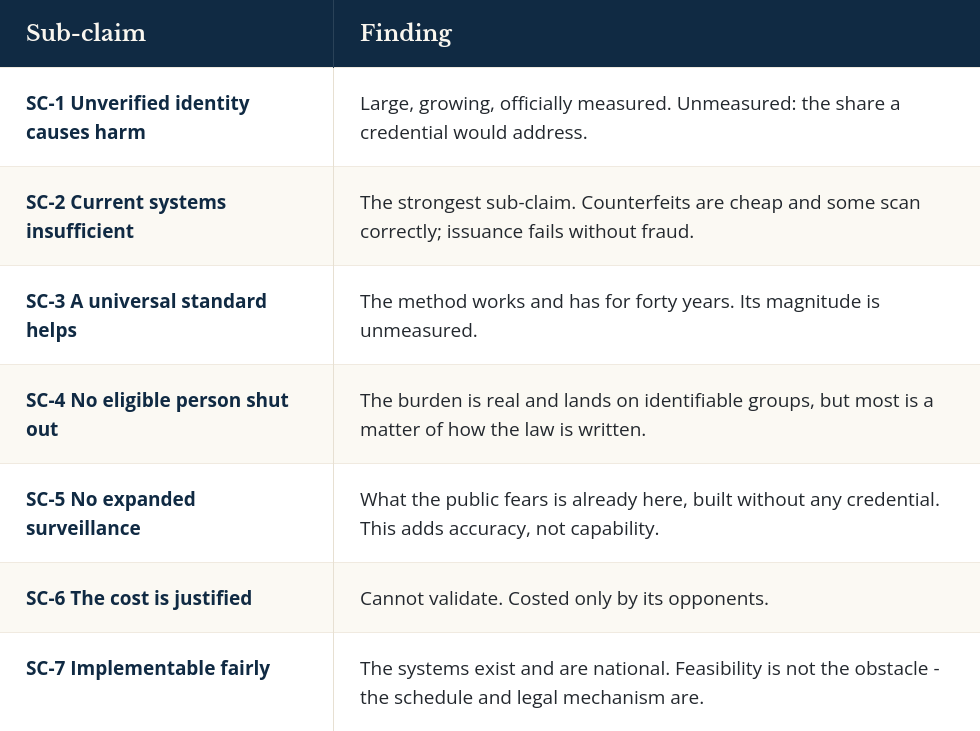
The registry holds 92 facts: 43 affirming, 22 dissenting, 27 neutral, each linked to its end source. Seven sub-claims were tested against it.
Our Verdict
The facts support this claim, conditionally.
On cost. Six of seven sub-claims survived. The seventh could not be validated, because no independent estimate exists. The question is what it costs to extend a system already built, not to build one - which no one has calculated.
On surveillance. This should become law only with the limits written into it - a closed list of permitted uses, a private right of action, and access logs the individual can inspect. A version without those limits is a different proposal, and we do not support it.
On enactment. The Supreme Court has held that Congress cannot compel a state to enact or enforce a federal program. No case establishing that rule involved national security or foreign policy, but we suggest the most expedient path is to follow the model of REAL ID: The requirement falls on the person, not the state. No state is compelled and no resident is excluded.
How It Would Work
Each government does the work it already does.
- The State Department confirms citizenship, as it does for every passport.
- Homeland Security sets the standard, confirms lawful status for non-citizens, and operates the shared biometric record it runs today.
- State motor-vehicle offices collect the documents and biometrics and issue the credential - they gather; they do not decide. Where a state declines, Homeland Security enrolls its residents directly.
Enrollment is completed within five years; credentials renew every eight. Roughly half of adults already hold a passport, so their citizenship is confirmed by records check - though all still require biometric enrollment, because United States passports record no fingerprints.
A National Identity Service Corps carries the work: Federally funded, drawing on the National Guard, active and retired military, and others who wish to serve. This country has organized an effort of this size before - more than three million men served in the Civilian Conservation Corps. Funding comes from a modest fee rather than general revenue, and ends when enrollment ends.
Read the Full Report
Q1 | Meaning explains what the claim means. Q2 | Evidence holds all 92 facts with live links to their sources. Q3 | Impact tests each of the seven sub-claims. Q4 | Solution presents our proposed solution for the common good, including a draft law and the path forward.
Follow the links below - and judge the evidence for yourself.
Forward this to others.
If you are a Member, please comment.