
Every adult must maintain a current government-issued photo ID verifying identity and citizenship status.
Meaning ┃ Evidence ┃ Impact ┃Solution ┃Summary

Who And What Does This Claim Impact?
Evidence is noted in [ ]
I. Introduction
Q1 | Meaning explained what this claim means. Q2 | Evidence listed the facts. Below we explore what happens if the claim becomes law - who and what are affected, and how much. Our proposed solution is provided in Q4 | Solution.
We run every claim through four tests to consider its impact:
- Who and What are affected?
- How Big is it, based on the evidence?
- Options: What can be done to limit the negatives and increase the positives?
- Projections: What happens over time?
NOTE: Evidence is referenced in [] - e.g., Evidence A-000075 is listed as [A-000075] and can be found on the Evidence page.
We trust evidence in this order:
- Laws and court records
- Official records and audits
- Peer-reviewed studies
- Surveys - estimates, not counts (see “Is That a Fact?”)
- Claims from advocacy groups
II. Solution Dependencies: What This Claim Needs to Work
This claim requires every adult to hold one credential answering three questions: Who are you? May you be here? Are you a citizen?
The following dependencies are important to this claim.
#1 - One person, one identity.
Due to advancing security threats from technology and AI, this claim seeks to fully confirm every individual citizen and visitor to our nation exists only once in the federal government identification systems.
This claim adopts the standard proven at national scale: Ten fingerprints and both iris images, collected once at enrollment and renewal. Used together they produce more than ten times fewer errors than either produces alone,[A-000125] and single-fingerprint matching fails outright above a million records.[N-000138]
The infrastructure exists. India confirms a single identity for more than 1.4 billion people using this combination,[A-000126] and the United States already operates two biometric systems at national scale (SC-7).
Offenders commonly use false names that a name-based check will not detect, and fingerprints are a proven method of identification.[A-000076]
What our current systems do not include are people who have never had an encounter with DHS or been convicted of a crime. None were built by enrolling the general population, and the current U.S. general population credential process collects no fingerprints or iris images at all - it fingerprints many types of government employees involved with these systems, but not the general public.[A-000144]
#2 - Issuance must be sound.
The accuracy of a credential depends on the process and people that issued it. Two states have demonstrated the impact of failure:
- A New Jersey software error enrolled roughly 6,600 noncitizens over a year.[A-000059]
- Oregon mis-recorded more than 1,600 applicants because staff selected the wrong document type.[A-000060]
Neither was fraud. Both were administrative failure, undetected for months or years. This dependency sits inside SC-2, and the strength of this claim depends on creating and maintaining one credential per individual.
#3 - Voting. Claim #04-003-002 proposes photo ID and signature verification at the time of voting, and names this claim as a dependency.
A universal credential recording citizenship makes verified voting simpler; verified voting is one of the strongest public justifications for the credential. Each is tested separately.
#4 - Limits on what government may collect and how it may use it.
This claim proposes one credential. This data, separate of biometric information, is already being collected by the government and has existing laws limiting its access and usage. These systems were built without a national credential mandate.[A-000103, A-000105, A-000108]
Surveillance concerns are considered under SC-5. Government data collection and permitted use will be researched by our team as separate claims.
#5 - Each government agency does the job it already does.
This claim assigns no new function to any agency. The division of work is set out in Q1 | Meaning, Section IV: The State Department confirms citizenship, Homeland Security sets the standard and operates the biometric repository, and state motor-vehicle offices collect and issue.
- Each dependency fails without the others. A credential built on unsound issuance, or without limits on use, is not the credential this claim proposes.
III. Testing Each Sub-Claim
SC-1 | Unverified identity causes real harm, and the harm is likely undercounted.
The harm is documented:
- The FTC received more than 1.1 million identity theft reports in 2024.[A-000067] Reported fraud losses across all categories reached $12.5 billion that year, a 25 percent jump, though most came from investment and imposter scams rather than credential fraud.[N-000101]
- Industry estimates put 2025 identity fraud losses at $27.3 billion against a record 3,322 U.S. data compromises,[A-000074] and the FBI recorded $16.6 billion in reported cybercrime losses in 2024, up 33 percent.[N-000099]
- Synthetic identity fraud - a fictitious person built on a real Social Security number - is the fastest-growing type of identity theft, and the numbers are most often taken from children, the elderly, the homeless, and the dead, because nobody notices for years.[A-000068]
- All but one of the nineteen September 11 hijackers acquired some form of U.S. identification, some by fraud, and those documents let them board flights and rent cars.[A-000065]
- Between 11 and 14 million illegal immigrants live in the United States, a figure produced by estimating the foreign-born population and subtracting the lawfully present.[A-000113, N-000114, N-000115] Most hold no document answering if they may be here or whether they are citizens.
- Congress has asked the Secretary of Homeland Security why the official estimate and the leading independent estimate differ by millions.[A-000116] A growing share of that population entered legally, was recorded at the border, and then vanished from the record as they overstayed their visas.[A-000117]
- CBP states that counterfeit identity documents are used by foreign terrorist organizations, criminal organizations, and fraud schemes to avoid attracting attention.[A-000080]
- Aliases defeat name-based records checks, and law enforcement says so in its own public guidance.[A-000076]
What the evidence does not show:
- Federal terrorism data is not generally collected in a form that records whether an offender held valid identification, held several identities, or had overstayed an admission.[D-000090]
Summary of SC-1: The harm is large, growing, and officially measured.
What is not measured is the extent a required universal credential would limit or eliminate the harm. Most identity theft is theft of identity data - a stolen Social Security number used to open an account online, where no document is presented.
The largest category reported to the FTC in 2024 was credit card fraud, and more than 406,000 of those 449,000 reports involved newly opened accounts.[D-000102] The FTC publishes report counts, but not losses by category, so the share a credential would address cannot be priced from the public record.
This credential is focused on identity confirmation, not confirmation of other documents or accounts an individual acquires. It reaches three categories:
- Fraud committed by presenting false identification to a person or a scanner.
- Synthetic identities, which a biometric check at issuance would catch.
- One person or entity currently or attempting to operate under several enrollments.
There is another important fact to consider: DHS recorded 538,548 overstay events in Fiscal Year 2024.[N-000100] We have found no research measuring the cost or the risk carried in that number, but it is reasonable to think the cost is significant.
SC-2 | Current systems are insufficient, and technology is making them weaker.
The standard took twenty years to arrive:
- The 9/11 Commission recommended federal standards for identification sources in 2004.[A-000066] REAL ID was enacted in 2005.[N-000092] Enforcement began May 7, 2025, after repeated deadline extensions.[N-000094]
Meanwhile the counterfeits improved:
- CBP seized 19,888 counterfeit U.S. driver’s licenses at one Chicago facility in just six months of 2020.[A-000077] Louisville seized 7,789 in fourteen days in 2022; Chicago 4,345 in a single month of 2025.[A-000078]
Two details in those seizures matter more than the volume: Many licenses shared one photograph across different names, and the barcodes on counterfeit Michigan licenses scanned correctly.[A-000079]
- An online service sold realistic fake IDs for $15.[A-000013] The Treasury has warned that AI-generated identity documents are defeating verification at financial institutions.[A-000014] The Federal Reserve reports generative AI now automates synthetic identity creation, including fabricating supporting records.[A-000069]
- Foreign documents carry a verification gap. Nineteen states accept a foreign birth certificate, passport, or consular card to establish identity,[A-000119] and no American authority can check those records against the government that issued them.
A September 11 hijacker was admitted on a passport carrying fraudulent stamps the inspector did not detect and, in the Commission’s assessment, could not have been expected to detect.[A-000124]
And issuance itself fails:
- Congress passed laws that authorized exceptions to existing immigration-related laws. Section 202(d)(11) of the REAL ID Act expressly permits states to issue credentials that are not acceptable for federal purposes,[N-000122] and federal law permits states to extend benefits to illegal immigrants by affirmative state statute.[N-000123] Nineteen states used both provisions.[N-000118]
- A non-compliant card fails to confirm if the holder is here legally. States must mark these cards as unacceptable for federal purposes. DHS warns the current marking says nothing about immigration status.[N-000098]
- New Jersey: ~6,600 improper registrations from a software error, undisclosed for up to three years.[A-000059]
- Oregon: 1,600+ from staff mis-selecting document types.[A-000060]
- The current process collects nothing that would catch a duplicate. States must run fingerprint-based criminal history checks on motor-vehicle employees who can affect what appears on a license. Applicants submit no fingerprints; the only biometric collected is a photograph.[A-000144]
- The scale is significant. California alone issued 110,000 such credentials in the first seven weeks of its program and projected 1.4 million over three years.[N-000120]
Summary of SC-2: It is true that current systems are insufficient, flawed, and under attack by criminals.
- The safeguards are weaker than the public assumes, and the tools to defeat them are cheaper and better every year.
- A seizure count is a floor, not a total - nothing in the record establishes what share of shipments is caught - so the true volume of fake IDs in circulation is higher than the numbers above, by an unknown multiple.
SC-3 | A universal standard would reduce the harm.
What supports it:
- The standard this claim adopts is measured, not assumed: Ten fingerprints and both iris images together produce more than ten times fewer errors than either alone,[A-000125] and the combination confirms a single identity for 1.4 billion people today.[A-000126] Name-based identification does not work at this scale.[A-000076, N-000138]
- When the REAL ID requirement arrived, people accepted it. Compliance at airport checkpoints ran 81 percent on the first day of enforcement, 93 percent two weeks later, and above 94 percent by December 2025.[A-000070]
New standard:
- The Interstate Identification Index already removes duplicate records for anyone arrested for a felony or serious misdemeanor. Yet, it does not consider people without an arrest record - which is the majority of our population. This claim would include everyone for the first time.[D-000091]
- No country comparable to the United States has adopted this exact requirement, so no measured prevention data exists anywhere.
Summary of SC-3: The evidence establishes that existing methods limit the harm, but the data has limits and does not measure what a universal credential would add:
- The method works, at national scale, and has for forty years.
- Current data does not confirm the magnitude of benefits - how much harm a universal credential would actually prevent.
- Criminals - anyone with an arrest history - who has multiple identities gets caught today.
- People without an arrest record, whether through innocence or simply never having been caught, are not considered.
Our Q4 | Solution must weigh these facts.
SC-4 | All eligible people would be able to obtain and maintain one.
Who could be shut out:
- A survey estimates more than 49 million American adults lack government-issued photo identification with their current name and address.[D-000018] (Survey estimate, weighted.)
- GAO found an average $54 charge for a state ID across ten states, before the documents needed to apply,[D-000081] and a Harvard institute put the full cost of a nominally free ID at $75 to $175.[D-000032]
- People experiencing homelessness face compounding barriers: No safe place to store documents, loss during evictions and encampment clearances, no residential address, no transportation.[D-000082]
- A circular barrier is documented: A birth certificate is required to get an ID, and a photo ID is required to get a birth certificate.[D-000083]
On the other side:
- REAL ID compliance moved from 81 percent to above 94 percent within months of enforcement.[A-000070] When people needed the credential, most got it quickly.
Options:
- Make the credential free along with the underlying documents for those who meet a standard of need. The cost should be a burden of state governments and could be covered by an increase in driver’s license fees or other state fees.
- Break the circular barrier by statute - a single verified enrollment producing both records, rather than each requiring the other[D-000083] - and accept an alternative to a residential address, since the two-proofs-of-residence rule is the provision that excludes people without one.[D-000082]
- Mobile unit issuance staffed by government employees, reaching people who cannot reach an office.
- Embrace the biometric confirmation of this claim - 10-fingerprint and both iris scans - to fully confirm people who lack an address.
Projections - what is left:
- The residual burden is documents, travel, and time - the three costs that survived every free-ID program studied.
- The homeless population is the most challenging, but as mentioned above, there are solutions.
Summary of SC-4: There is a burden, it is measurable, and it is reasonable for the vast majority of people and resolvable for the rest.
- The REAL ID experience suggests the residual group - people without identification - is smaller than the survey estimates imply once the credential is actually required.
- The fixes are known and listed above: A free credential, free documents, mobile issuance, and a statutory end to the circular barrier.
- The exception is people without an address, for whom the current federal standard is not merely burdensome, but disqualifying as written.
SC-5 | The requirement does not expand government surveillance of law-abiding people.
What supports it:
- The government says so itself. A declassified report by the Director of National Intelligence found that the intelligence community buys growing volumes of commercial data, including sensitive location data, and does not know how much it holds or what it does with it.[A-000103]The same report states that government could never have compelled people to carry tracking devices or log their reading habits - yet smartphones, connected cars, and web tracking produced that effect anyway.[A-000104]
- What agencies buy and scrape dwarfs any credential. Six federal agencies have bought smartphone location data from commercial brokers, and FOIA litigation confirmed ICE and CBP bought bulk cellphone location data harvested from apps. [A-000105]Clearview AI holds contracts with over 3,000 agencies and claims 10 billion scraped images, against roughly 640 million in the FBI’s own database, [A-000106] and GAO found five federal agencies using facial recognition to determine whether a person is present at a location. [A-000107]
- Communications are queried in the millions. The FBI ran more than 3.3 million warrantless searches of Americans’ communications in a single year under an authority nominally limited to foreigners abroad. [A-000108] Reported numbers have fallen sharply since, though the totals are incomplete and the FISA Court found the undercounting ongoing in March 2026.[N-000109]
- None of current government surveillance was built to support an identity card. It was done for national security and/or public safety. Roughly 119,000 license plate reader cameras operate nationwide, capturing plate, location, and time, retaining the data to track movement, and comparing it against watch lists.[A-000073, N-000097]
- The Driver’s Privacy Protection Act limits DMV personal information to fourteen permissible uses, sets penalties, and makes violators civilly liable to the individual. [A-000071] It is a federal floor - states may be stricter[N-000095] - and the courts enforce it in both directions.[A-000072]
- The interstate sharing this claim would rely on already exists under REAL ID.[N-000085]
The objections:
- Restrictions get violated. Officers have used license plate reader access to stalk former partners and surveil protestors, and a New York Inspector General investigation found DMV employees improperly accessing motor-vehicle records in breach of both federal law and department policy.[D-000087]
- Limits erode. The Social Security number was created in 1935 to identify covered earnings and became a universal identifier across government, credit bureaus, hospitals, and schools.[D-000086]
- The restrictions are narrow in reach. The DPPA’s permissible uses include a broad grant to any government agency carrying out its functions,[N-000096] and the framework ODNI released in 2024 restricts no category of data agencies may purchase, including location and web browsing.[D-000112] The DPPA covers motor-vehicle records. Nothing comparable covers what agencies buy.
- Facial recognition produces ranked probability scores that fail, but is not part of this claim. At least eight Americans have been wrongfully arrested on facial recognition matches with no corroborating evidence, seven of the eight were Black.[N-000110] Detroit’s police chief acknowledged his department’s system was wrong 96 percent of the time as a sole identifier, and the department kept using it.[D-000111]
Options:
- Give the individual a right of action, as the DPPA does.[A-000071] Enforcement that depends only on an agency policing itself is the pattern that already failed.
- Require access logging that the individual can inspect - the person can see who looked at their record and why. However, current laws probably limit these logs and the reasons why records were reviewed.
- Give law enforcement a reliable tool and require its use. Confirming identity is part of the job, and this credential exists in part to make that possible. The wrongful arrests went wrong not because police checked identity, but because a facial recognition match was treated as the sole test for identification.
Federal guidance already holds such matches are investigative leads requiring verification. The statute should require that where identity matters, it be confirmed against the credential rather than inferred from a probabilistic match.
Summary of SC-5: Surveillance the public fears is already happening, confirmed by the government itself.[A-000103, A-000104] Location data bought without warrants,[A-000105] facial recognition at ten billion images,[A-000106] millions of warrantless queries of Americans’ communications.[A-000108]
None of it was built on an identity credential, and none of it is governed by anything as strong as the Driver’s Privacy Protection Act.
- What government holds today is bought, scraped, and uncertain. Restrictions on identity data have been broken before.[D-000087]
Against that background, this claim adds a better index with possibly better guardrails rather than a new power.
In contrast, a verified credential is exact, and precision makes a large system more accurate and valuable for national security and public safety.
- The law must be written with a closed list of uses, a private right of action, inspectable logs, regular reporting, and a process for accountability. Consequences are not defined as part of this claim’s Q4 | Solution.
SC-6 | The cost and effort are justified.
What the cost side shows:
- Contemporary estimates of a national identity system ranged from $4 billion at minimum to $25-30 billion to establish, plus $3-6 billion a year to operate.[D-000088] A separate estimate put REAL ID implementation at roughly $17 billion, with states bearing the majority.[D-000089]Both figures come from organizations opposed to the proposal. We have found no independent or official cost study of a universal requirement built on existing systems.
- The federal agency that would confirm citizenship is already strained. Passport processing ran more than four weeks longer than pre-pandemic in Fiscal Year 2023, driven by record volume and staff shortages, with more than 250,000 hours of overtime,[D-000133] and its modernization plan had defined milestones for 24 of 83 projects as of December 2024.[D-000134] It issued more than 27 million passports in Fiscal Year 2025, its highest year.[N-000136]
- For the individual, the cost is $54 on average for the card,[D-000081] and $75 to $175 total including travel and other possible costs.[D-000032]
What the benefit side shows:
- Lacking a compliant credential already carries a price: TSA charges $45 to a traveler who arrives without acceptable identification.[A-000084] That fee exists because handling a missing or false credential costs money, and the person responsible for the violation is required to pay for it.
- Against those costs sit $12.5 billion in reported fraud losses in one year,[N-000101] and $27.3 billion in estimated identity fraud losses in another.[A-000074] What no source establishes is how much of that a required universal credential would stop. This is noted in the summary of this section.
Options:
- Consider a five-year national effort to update people’s identification in our government systems to remove duplicates, update data to optimum accuracy, add fingerprint and iris scans, and thwart crime.
A national effort at this scale is not unprecedented. More than three million men served in the Civilian Conservation Corps between 1933 and 1942, the largest peacetime mobilization in American history, with the Department of Labor recruiting, the Army running camps, and each state enrolling under a population quota.[A-000129, A-000130] The recruiting conditions today are not the same as then, during the Depression when unemployment was near 25 percent.
These people and the technology to support them could supplement state motor vehicle staff to serve people through this new identification process for a five year period. The goal is all Americans and approved visitors have completed the process within that timeframe.
Summary of SC-6:
We cannot validate:
- An unbiased estimate of the cost of this claim because currently the only estimate has been made by its opponents.
- The full benefits because current numbers are not limited to the specific problems the credential would address.
- We have confirmed:
- The infrastructure this claim needs already exists and is paid for (SC-7). The marginal cost of a universal requirement is not the cost of building a system. It is the cost of extending one. That is a materially smaller number than the estimates describe,[D-000088] and nobody has calculated it.
- There is an unknown cost for new technology to support the requirements of this claim, and a five year term of temporary staffing to have people complete their initial enrollment.
SC-7 | It can be implemented fairly and uniformly, and the process already exists in multiple states.
It is already built:
- Every state, the District of Columbia, and the five territories issue REAL ID-compliant credentials, certified by DHS.[N-000093]
- The Enhanced Driver’s License has provided federally recognized proof of identity and citizenship since 2009 in five states. In Washington alone 2.26 million people hold one, a third of that state’s cardholders,[A-000127] and the state absorbed 168,000 original applications in a single quarter of 2025 - a 148 percent increase - at about five extra minutes per transaction.[A-000128]
- The national fingerprint index has operated since 1983,[A-000075] and DHS operates a biometric repository of more than 320 million identities alongside it.[A-000140, A-000141]
- REAL ID compliance climbed from 81 percent to above 94 percent in months once enforcement began.[A-000070]
The limits:
- Twenty years elapsed between enactment of REAL ID and enforcement, across repeated extensions.[N-000094] Whatever schedule is the goal, the real one could be longer. It depends on budget and management.
- Implementation met sustained multi-state resistance, and states bore most of the cost. [D-000089]
- States are legislating in opposite directions on the same credential: Nineteen issue them to illegal immigrants,[N-000118] and three have passed laws refusing to recognize those credentials from other states.[D-000121]
- The two-proofs-of-residence requirement excludes people without an address as written.[D-000082] One design choice, an entire population shut out.
- Maine prohibits by statute the use of biometric technology to produce identification documents.[D-000145]
- Two attempts to add a sixth citizenship-confirming state have failed: California’s legislature passed a bill that was vetoed over the tracking risk, and Ohio enacted a law and issued no cards.[D-000132] Each state that does issue one negotiates its own federal agreement, separately audited and separately designated.[N-000137]
- The Supreme Court has ruled the Constitution limits what can be required of a state in the areas of the Fugitive Slave Act (1842), radioactive waste (1992), handgun background checks (1997), and sports gambling (2018).[N-000147]
The Supreme Court has held that Congress cannot compel a state to enact or enforce a federal regulatory program, or reach the same result by directing the state’s own officers - and it added that no case-by-case weighing of burdens or benefits is necessary.[D-000146]
However, the Supreme Court has not ruled on this question where national security or foreign affairs is the federal interest.[N-000147]
Summary of SC-7: The systems exist, are national, and have already absorbed a universal-scale rollout.[N-000093, A-000070, A-000127] Feasibility is not the obstacle. Two other things are.
- The schedule. Twenty years passed between enactment and enforcement of the current REAL ID standard.[N-000094]
- The mechanism. This claim may need Supreme Court review.
What remains open is the path the current standard already used.
- Federal law may preempt state regulation and may condition a state’s ability to regulate on conformity with federal standards.[A-000148]
- Federal authority is strongest where foreign affairs and naturalization are concerned, and a state may not contradict a federal determination of status.[A-000149]
- REAL ID compelled no state and still reached 94 percent compliance,[A-000070] because the requirement fell on the person, not the state.
A state may decline to participate. Its credentials then do not satisfy the federal standard, and its residents must still obtain one under federal law - the requirement of this claim can still reach every adult. Q4 | Solution must be written that way.
IV. Common Scenarios
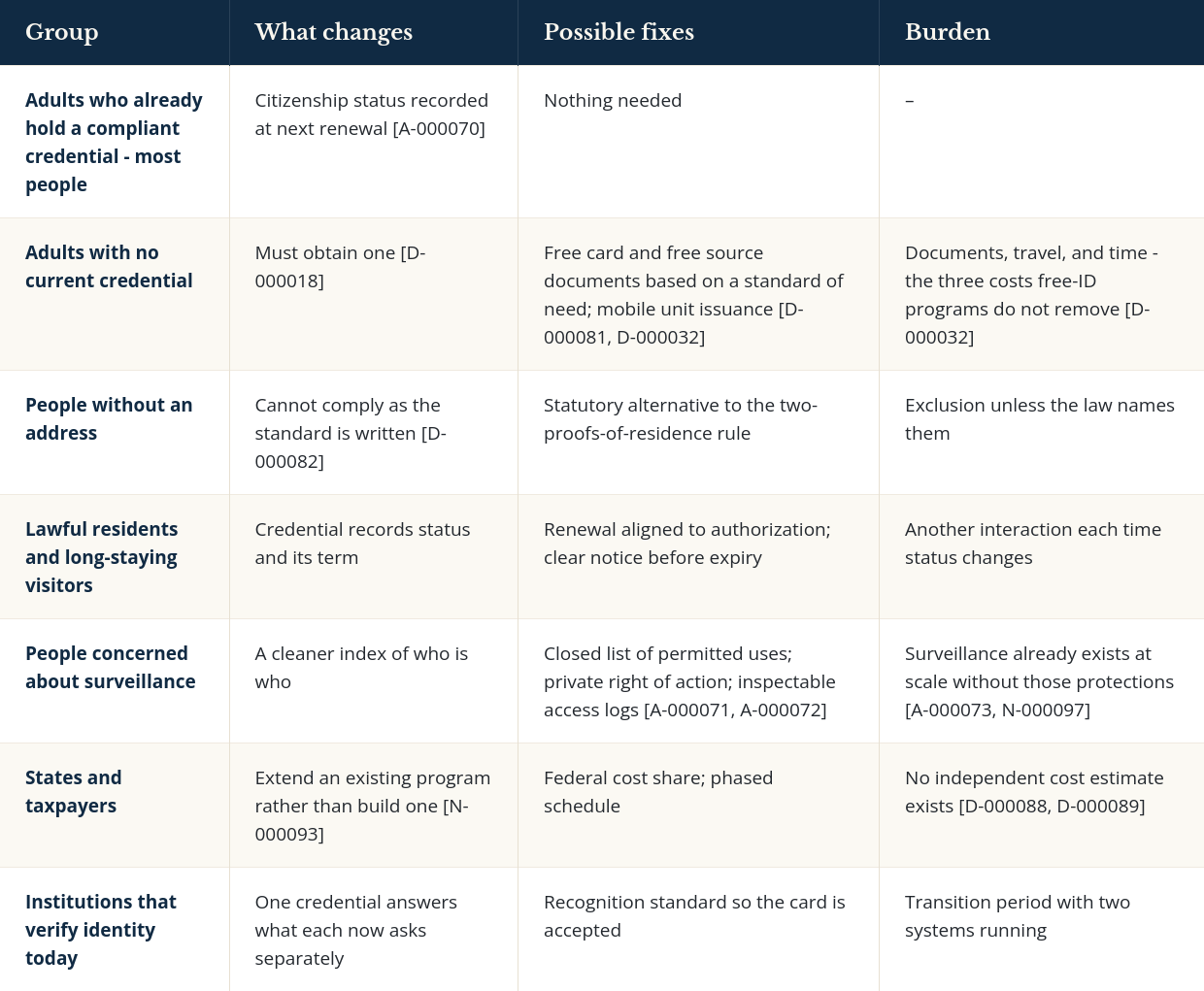
- You already have a REAL ID. Nothing changes until renewal, when the credential would record citizenship status as well as identity. This is most adults in America - more than 94 percent of travelers already carry a compliant document.[A-000070]
- You already have a passport. The expensive step is done - the federal government has already determined you are a citizen. What remains is biometric enrollment, because U.S. passports record no fingerprints.[N-000135]
- You have never held identification. You need a birth certificate to apply, and in some places, you need a photo ID to get the birth certificate.[D-000083] The cost is the one established under SC-4: $54 for the card, $75 to $175 all in.Cost to the person: Real, and front-loaded. Cost to the state: Fee waivers and one-time enrollment support for those who meet a standard of need. Costs can be offset by higher driver’s license fees or other state fees.
- You have no address. The federal standard requires two proofs of principal residence.[D-000082] As written, you cannot comply. This is not a burden that money alone fixes; it requires a different rule. A solution also increases the need for biometric identity confirmation.Cost to the person: Total exclusion, absent a change in the law. Cost to the state: An alternative verification path, which several states already operate for other purposes.
- Your card expires. A duty to maintain implies a moment of non-compliance. What follows from that moment is a Q4 | Solution question, and this claim proposes consequences only for failure to maintain - not police procedure. Q1 | Meaning, Section VI states that boundary.
- You are here on a visa and stay past ninety days. You cross the threshold in Q1 | Meaning, Section V and must obtain an American credential recording your status and its term. DHS recorded 538,548 overstay events in one year,[N-000100] so this scenario is not rare.
- You are already enrolled twice. Some people are, innocently and otherwise. Resolving those cases is more straightforward when there is a process in law for biometric confirmation of identity (Section II).
- Your state refuses to participate. One state already prohibits biometric identification by statute.[D-000145] Its credentials would not satisfy the federal standard, and its residents would obtain a federal credential instead. The state is not compelled and its residents are not excluded.
V. Who Feels This Law
VI. Impact Conclusion
- Here is our conclusion regarding the impact should this claim become law:
- It is reasonable to expect meaningful improvement in national security and public safety from enacting this claim, especially as technology advances. However, we could not find an estimate of how great the benefits may be.
- There is a significant cost for new technology and staffing to implement this claim as an upgrade to the REAL ID or EDL system, or a pairing of two systems, such as REAL ID and passports. We could not find an estimate based on how this claim is written.
- A person without an address cannot satisfy the two-proofs-of-residence requirement as written.[D-000082] This requires a solution, or solution options for states to choose.
- Implementation details of this claim, including cost and timeframe, are dependent on the federal system or systems chosen to update.
- There are two possible legal paths for implementation of this claim: (1) Federal mandate to states, which the Supreme Court’s rulings appear to foreclose, though no case establishing that rule has involved national security or foreign policy;[D-000146, N-000147] or (2) Federal mandate to citizens, the path the current standards have already used.[A-000148]
- This claim does not change what government may collect or how it may use it. However, the claim, in its final form as law, is an opportunity for citizens to specify reasonable limits, reporting, and accountability that protect rights while enabling national security and domestic law enforcement to do their jobs.
We encourage you to consider our proposed Q4 | Solution.